The Wind Gate: Why Chinese Medicine Takes Your Neck So Seriously
Sep 24, 2026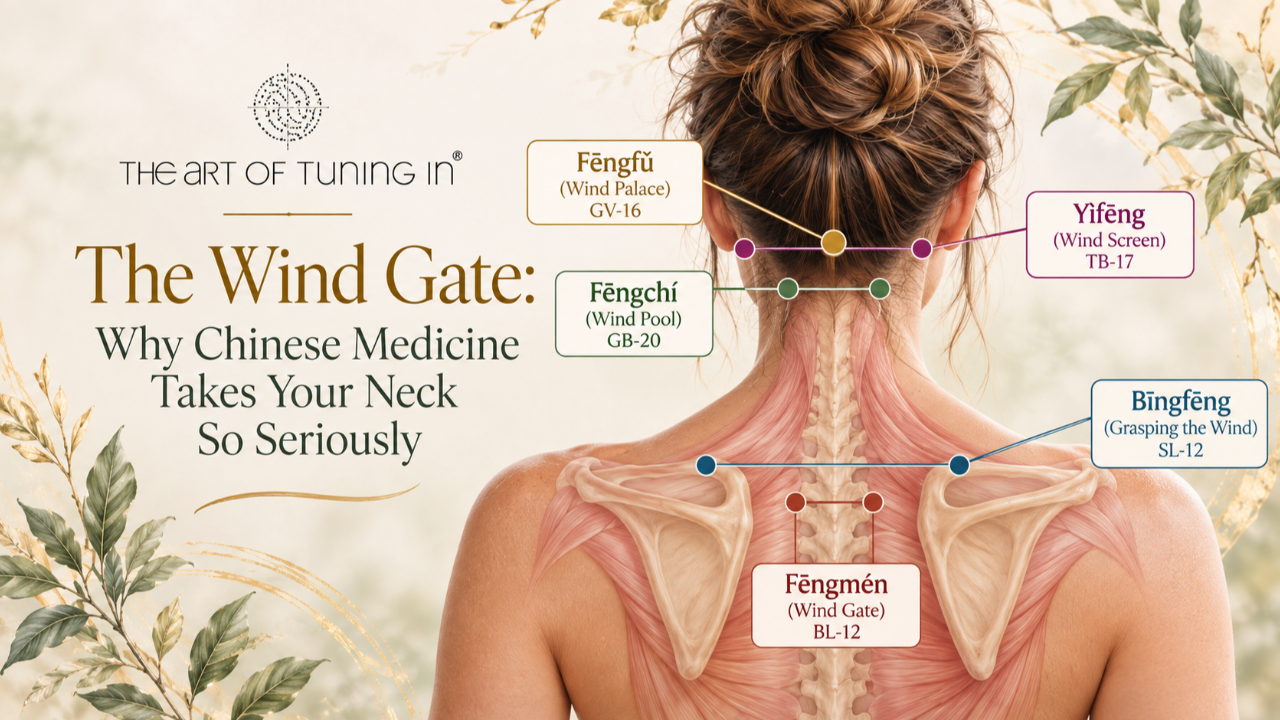
Wind: The "Chief of the Hundred Diseases"
In Traditional Chinese Medicine, Wind (Feng) is one of the primary external pathogens, forces from the environment that invade the body and disrupt health. Wind is unique: fast-moving and changeable, it's often the carrier that lets other pathogens, like Cold or Heat, sneak in alongside it. That's why an old TCM saying calls it "the chief of the hundred diseases," it opens the door for everything else.
And Wind has a favorite entry point: the back of your neck.
Meet the Wind Gate Points
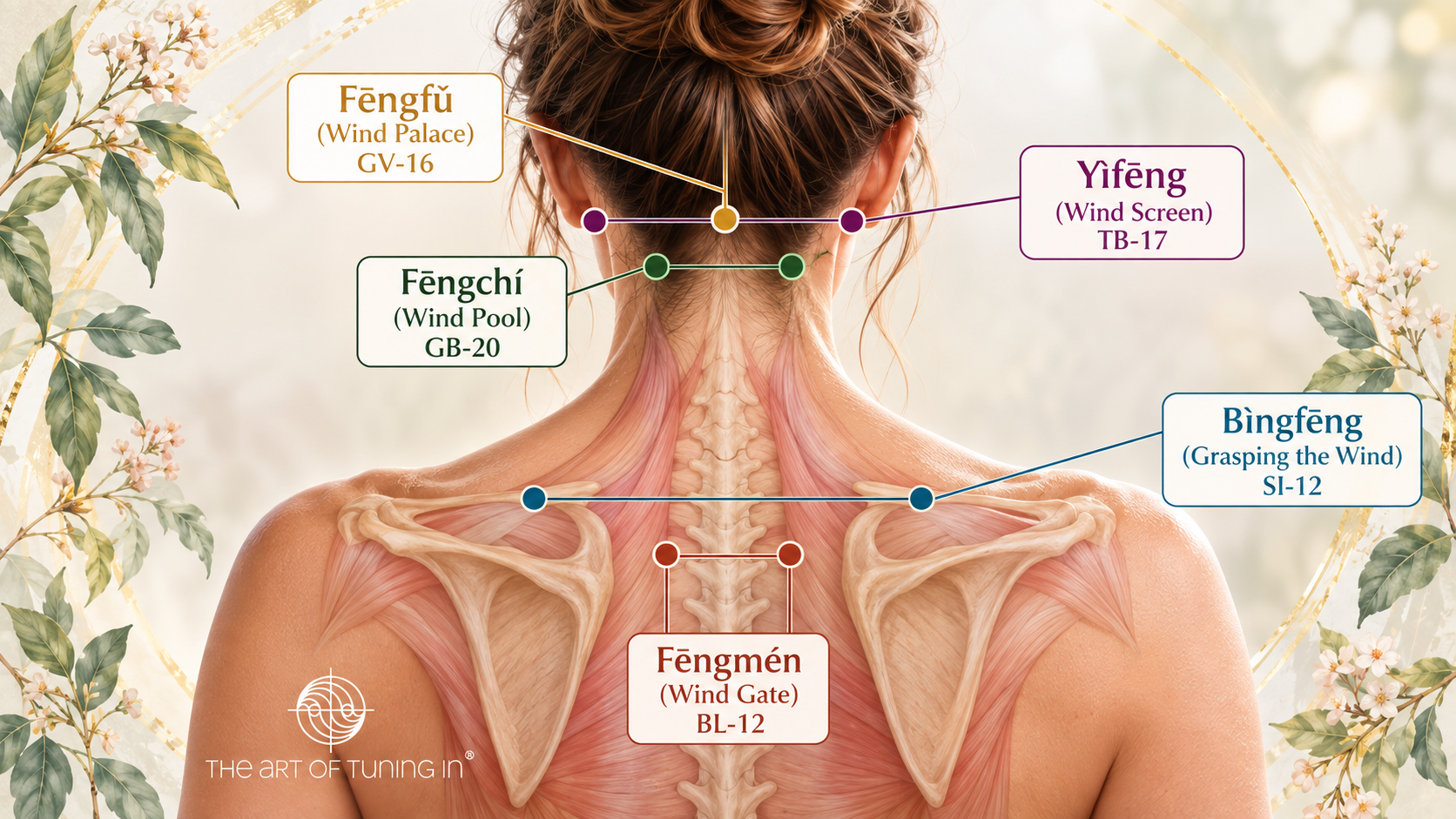
Right along the base of the skull and across the upper back and shoulders sits group of acupuncture points whose names literally contain the character for Wind (风, Feng):
- Fēngfǔ (Wind Palace) GV-16 — midline, at the base of the skull
- Fēngchí (Wind Pool) GB-20 — bilateral, at the base of the occiput
- Yìfēng (Wind Screen) TB-17 — bilateral, behind the ears
- Bìngfēng (Grasping the Wind) SI-12 — bilateral, in the scapular region
- Fēngmén (Wind Gate) BL-12 — bilateral, upper back near T2
These points sit right where the neck's muscles, vessels, and nerves are most exposed, less protected by fat or bone. In TCM theory, that makes them the easiest place for external Wind, a cold draft, a sudden gust, air conditioning, to breach the body's defenses.
What Happens When Wind Gets In
Classical Chinese medicine ties neck and upper-back exposure to a familiar list: a stiff neck, tension headaches, that achy, foggy feeling right before a cold, even the first signs of flu. The logic follows the meridians running through this region, the Governing Vessel and Bladder channels, both considered the body's first line of defense.
So that sudden chill down your neck? It's TCM's original wearable warning system.
Here's the mechanism:
- Wind and Cold penetrate the pores and settle into the muscle layer beneath.
- The cold tightens the muscles, the pores clamp shut in response, and the pathogen gets trapped inside instead of released.
- This is exactly why massage and Gua Sha work, both reopen the pores and release the tightened muscle, giving the trapped Wind, Cold, and Damp a way out.
The Scarf as Medicine
This is why high collars, silk scarves, and wrapped necks run through traditional Chinese dress, from the mandarin collar to simply tucking a scarf snug before stepping outside. It's not just style. It's everyday preventive medicine: keep the Wind Gate covered, keep pathogens out.
This still shows up in modern practice. Practitioners often advise:
- Postpartum women, whose Qi and blood are considered depleted, to keep the neck and head covered even indoors
- Children and the elderly, whose defensive Qi (Wei Qi) is weaker, to avoid direct drafts on the neck
- Anyone feeling run-down, since a weakened system means a more vulnerable Wind Gate
Miso Soup: An Herbal Formula in Disguise
Your classic bowl of miso soup with scallions may double as ancient medicine. TCM traces it to a formula first recorded around 300 CE for the earliest signs of Wind-Cold: chills, a stiff neck, no sweat, a runny nose.
The logic: scallions are warm and pungent, exactly what TCM uses to push Wind and Cold back out through the pores. Miso plays a gentler role, nourishing digestion so the body has enough fluid to sweat without depleting itself. Sip it hot, then rest under a blanket so the sweat can finish its work. Skip it, though, once a cold turns into a fever or sore throat, that's a different pattern.
A Few Simple Ways to Protect Your Wind Gates
- Keep a scarf on hand for windy, drafty, or air-conditioned spaces, especially morning and evening
- Avoid sleeping with a wet neck or hairline, dampness plus wind is a stronger combined invasion
- At the first chill or stiffness at the base of your skull, a warm compress or gentle self-massage at Feng Chi can help before symptoms build
- Notice fans and A/C blowing directly on your neck, small daily exposures add up
The Takeaway
There's more going on at your neck than you might think. In Chinese medicine, it's one of the body's most important checkpoints, and something as simple as a scarf can count as real preventive care.
So the next time you reach for something to wrap around your neck, trust it. That instinct has thousands of years of wisdom behind it.
References:
Huangdi Neijing (The Yellow Emperor's Inner Classic) Chapter 42 of the Suwen (Plain Questions), titled the "Discourse on Wind"
"TCM" Traditional Chinese Medicine